
Texts: Joel 2:12-17, Matthew 6
This homily was originally preached at Saint Stephen’s in Sherman, Texas, on Wednesday, February 18, 2026.
The ancient Romans had a phrase: memento mori. It means, Remember that you will die. And it was a tradition that a slave would whisper this in the ear of a conquering general after a victory. “Remember that you will die.” It was to remind him that even after triumph, even after the glories of this earth, death would come to him, just like it will come to the slave and just like it will come to all. Remember that you will die. Or as God said to Adam after the Fall, You are dust, and to dust you will return.
Mindfulness of death is one of the gifts of God. It is a gift of grace. To remember that we are mortal, that we will die, that our life on this earth is not endless– this is a gift. And it is a gift given to us for repentance. Because when we remember that we will die, that means we remember at least two things.
One is that our actions in this life matter. How we conduct ourselves in this world matters. If there was no death, if there was no aging, if we were able to live for centuries and centuries and centuries, that would mean that almost anything we did, if we were given enough time, we’d be able to reverse. “We got all the time in the world.” But we don’t have all the time in the world. So how we act and the decisions we make, how we conduct ourselves in the world matters. Because we only have so much of that time, and some of the things we do can’t be undone.
And if we lived forever, we wouldn’t really have any sense of waste either– wasting your time, wasting your energy. Well, you’ve got all the time you ever need. You can’t waste anything. No matter what you do, there will always be more. Of course, that’s not true either. Because our life is short, it is possible to waste our precious time on this earth. Sin is waste. It is a waste of our time and energy. That’s what prodigal means– wasteful. The Prodigal Son is the one who realizes that he’s wasted the love that his Father gave him.
So we remember our mortality, we remember that we will die– that we get seventy or eighty or so years on this earth and that’s it, and thence to eternity. That reminds us that how we live in this life matters. And that it is indeed possible to waste our time and energy and attention on things that don’t deserve it.
But mindfulness of death is not just a remembrance that we will die, but also a mindfulness of the death that is within us, in our hearts. If there is hatred, prejudice, lust, pride, vindictiveness in our hearts, that is death. They don’t just lead to death– those things are death. And they live inside of us because we are sinners. So the beginning of the Lenten season is a time to remember death, to remember that we will die and to remember that the forces of death are at work in the darkest parts of our hearts.
It’s these twin realities– our mortality and our sinfulness– that is meant to spur us on to repentance, to change. Remembrance of death, mindfulness of death, is supposed to bring us to compunction. It’s a word we don’t really hear very often. It means a holy remorse, a sorrow over our sins. It comes from the word for puncture, to be wounded. When we think about the ways in which we have sinned, the ways in which we have hurt others and hurt ourselves, the ways in which we have wasted what God has given us, that wounds us and it spurs us on to do something: to repent, to have a change of heart, to change the way we’re living. That’s what this holy season is for: to produce within our hearts compunction– that holy woundedness. When we realize our mortality and our sinfulness, we are wounded and we sorrow and we get angry.
There’s so many things we could get angry about in this life, so much that could enrage us. And what I’m saying, brothers and sisters, is you should get angry. Get angry! But not at the world, not at others. Get angry at your sins. Get angry at the dark parts of your heart. Get angry at all the things that separate you from God. Get angry with all the parts of you that are keeping you from being the person God made you to be. Get angry with your sins. Make war on your passions, your sinful habits. Don’t accept them as normal. Don’t become comfortable with them or accept them.
This is the time to have compunction, to be wounded, to think about the ways in which we’ve fallen short, and to get angry and get motivated to do something about it. Lent is a time to weep and lament and mourn, as God said to the prophet Joel in our first reading.
This is the time to do that. And God doesn’t tell us to do this all the time, all year long. There are in the church year seasons of feasting, seasons of joy. After all, Lent is a journey to Easter, which is a time of joy and celebration. So God doesn’t call us to do this all year. He calls us to do it for forty days. If you don’t count the Sundays, it’s about a tenth of the year. It’s just a tenth of the year. It’s a tithe to the Lord. We’re not called to do this all year round, but we are called to do it for forty days. We can manage that.
In the Lenten season, we are called to weep and mourn and lament our sins, not as an end in itself, but as a means to forsaking our sins, to renounce what alienates us from God. That is what we’re called to do. We’re called to renounce our sins and to turn to the loving God– who is our Father and who is so good and who loves us and who wants us to return to him. Because he is good and he’s so much better than sin, which is death. Christ is life. So we’re called to turn away from sin, to turn away from all the forces of death in our hearts, to be angry with all our pride and impatience and hatred and vanity– all the things that we’re going to confess in the Litany of Penitence very soon here.
We renounce all those forces of death within our hearts and we turn away from them and turn to Christ, who is Life, and we grab the hem of his robe. That’s what this holy season of Lent is for: to renounce death and to cling to life. That’s what God made us for. Not to die, but to live and to live eternally.
And so let us remember that we will die… but we need not die forever. We need not let death have power over us and keep us in bondage. Through repentance, through faith in our Lord Jesus Christ, through clinging to the infinite mercy of our loving God, we can turn away from death and cling to life and have life living in us.
Remember that you will die. But remember also that there is One more powerful than death– He is Life itself, and He is calling you into his embrace. Amen.
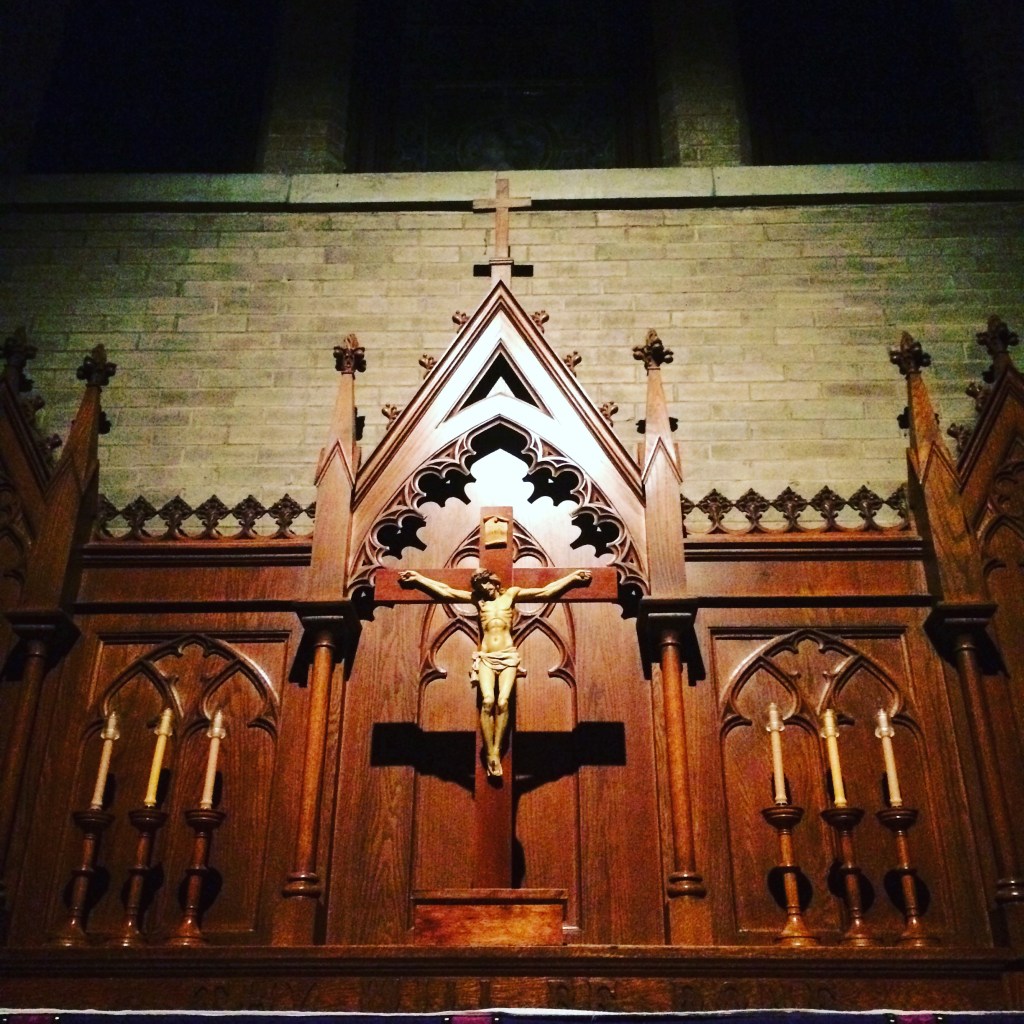
 The Pulpit and the Altar